
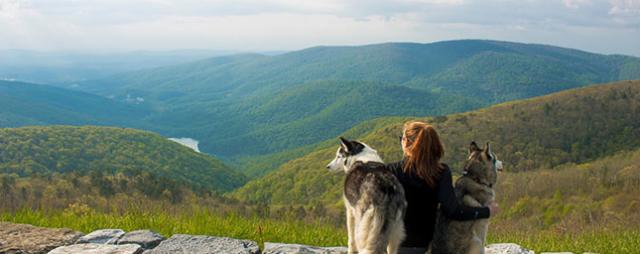
Virginia is chock-full of famous outdoor attractions like the Appalachian Trail, Shenandoah National Park, and Great Falls Park. Yet other natural locales are lesser known, but no less impressive. Virginia’s outdoor splendor can also be found in these unheralded places that you can discover and enjoy.
Read on and pluck your hidden Virginia outdoor jewel.
White Rocks Overlook

Cumberland Gap National Historical Park
Nearest Town: Ewing
Best Times to Visit: Whenever the skies are clear for best views
What You Need to Know: The trail faces south and is hot in the summer
It is worth the three-mile hike to the view-laden outcrop of White Rocks Overlook in Cumberland Gap National Historical Park. Far from most populated places, this overlook atop Cumberland Mountain delivers prolific panoramas of Southwest Virginia, Kentucky and beyond into Tennessee.
The Ewing Trail is your conduit, leaving Civic Park near the town of Ewing. Start switchbacking up the face of Cumberland Mountain before reaching the mountain crest and the Virginia/Kentucky state line. From there, the hike’s denouement leads up to a wide and open stone pinnacle, atop which you can revel in the Powell River below, Kentucky’s hills behind you and across Tennessee all the way to the Great Smoky Mountains.
Don't Miss: Consider a ½-mile side trip to Sand Cave on the Kentucky side of Cumberland Mountain, where an enormous overhang filled with yellow sand stands next to a waterfall.
Crow's Nest Natural Area Preserve
Nearest Town: Stafford
Best Times to Visit: Summer for warm weather paddling
What You Need to Know: Access will increase over time.
Visit Virginia’s next rising star outdoor attraction, Crow's Nest Natural Area Preserve. Over time, the state has cobbled together almost 3,000 acres of tidal freshwater marshes divided by steep hills to create the Crow's Nest. This biologically significant parcel of the Potomac River watershed is not only important to conserve, it also provides a place to paddle and hike for metro D.C. to the north, as well as adjacent communities.
More than nine miles of trails are are available for you to explore. Paddle the Crow's Nest Water Trail from an all-access paddler platform at Boykins Landing, then head four miles to Potomac Creek. Or take the path along Accokeek Creek overlooking wetlands.
Chief Benge Scout Trail

High Knob Observation Tower
Nearest Town: Dungannon
Best Times to Visit: Late spring for wildflowers, summer for swimming, best camping
What You Need to Know: Trail has many creek crossings
This 19-mile end-to-end backpacking or day hiking trail is filled with highlights from stem to stern. Multiple trailheads make day hiking the Chief Benge Scout Trail viable. Located in an overlooked parcel of George Washington and Jefferson National Forests, start off with a bang, soaking in 360-degree panoramas overlooking five states from the restored High Knob Observation Tower.
Descend to Stony Creek, passing a small lake and intimate campground at High Knob Recreation Area. Trek along Stony Creek — the valley of 10,000 ferns — then climb over a ridge to enter Little Stony Creek valley, rife with rich vegetation. Come to Bark Camp Lake Recreation Area, with an alluring lake, a fine campground and additional trails.
Beyond Bark Camp Lake, travel a secluded valley before coming to the Little Stony Falls. Three set of waterfalls deservedly draw in crowds for the final three miles through the Little Stony Creek Gorge before you end at Hanging Rock Recreation Area near Dungannon.
Powell River Canoeing & Kayaking
Nearest Town: Big Stone Gap
Best Times to Visit: Early spring through late spring for adequate water
What You Need to Know: Powell River gauge at Big Stone Gap should be between 250-800 cubic feet per second for ideal water flow.
At Big Stone Gap, the Powell River calms down enough for most recreational and casual paddlers, dropping a manageable five feet per mile (upstream of Big Stone Gap draws in whitewater enthusiasts). The 12-mile stretch between Big Stone Gap and Dryden features Class I-II rapids divided by longer, calm pools as it winds under the mantles of Stone Mountain and Wallen Ridge.
Put in at Bullitt Park in Big Stone Gap. The first part of the paddle leads you out of town. Float through a mix of woods and fields. A continual screen of trees keeps the atmosphere scenic. Watch for riverside bluffs. Allow ample time to make the 12-mile run. Anglers often vie for smallmouth bass. The takeout at Dryden is at the US 58 bridge, where a boat ramp on the east bank makes your egress easier.
Savage Neck Dunes Natural Area Preserve

Savage Neck Dunes Natural Area Preserve
Photo Credit: Suzanne Moss @thenaturebus
Nearest Town: Cape Charles
Best Times to Visit: Fall for birding
What You Need to Know: The parking area is small, with limited spots; bring bug spray during the warm season
Bring your camera – and your binoculars – to Savage Neck Dunes Natural Area Preserve. Known for sand dunes rising 50 feet high from Chesapeake Bay, the almost 300-acre preserve boasts a mile of wild frontage on Chesapeake Bay with stellar vistas from the sandy shoreline.
Heading inland, the big dunes give way to lesser dunes, then pines, oaks and cedars. Impressive loblolly evergreens rise to impressive proportions in the protected interior. The dunes are among the highest points on the Eastern Shore. Visitors accessing the preserve can trace a ¾-mile trail through the dunes to the beach. Birders peer through binoculars for neo-tropical warblers in fall.
Locust Springs Day Use Area
Nearest Town: Monterey
Best Times to Visit: Mid-spring through early winter
What You Need to Know: Lower Laurel Fork boasts attractive swimming holes in places
Held fast against West Virginia on two sides – you even have to go through West Virginia to get there – the secluded Locust Springs Day Use Area serves as the jumping off point for a 28-mile trail network coursing through the perched watershed of Laurel Fork. Elevations here in aptly named Highland County range from 4,000 feet down to 3,400 feet. Grassy, sometimes boggy meadows and beaver ponds are found on the upper reaches of streams, beneath rising wooded ridges where red spruce, birch and cherry grow thick.
Old railroad grades serve as the base of the trail network, with day loop hikes and overnight loop backpacks possible. Deer, beavers, and songbirds can be found around the meadows. The trail system is well signed but can become more difficult to follow in meadows. Expect to cross streams often along the trails. Conditions are driest in autumn.
Comers Rock Recreation Area
Nearest Town: Elk Creek
Best Times to Visit: Open mid-April through October
What You Need to Know: First come, first serve campground has only six sites, get here early on nice warm weather weekends
Comers Rock Recreation Area, elevation 3,400 feet atop Iron Mountain in the George Washington and Jefferson National Forests, features both a campground and picnic area. An old-time picnic shelter, with a stone grill, provides a rainy day possibility to this already attractive area, in a gap shaded by an oak forest.
Comers Rock is a quiet getaway for solitude seekers, especially during the week. The campsites have been leveled and each site provides a tent pad, picnic table, fire ring and lantern post. A water spigot and vault toilets complete the picture. Outdoor activities are immediate. The Unaka Trail offers a short course in the natural history of the area. The Comers Rock Trail takes hikers a half-mile to a superlative 360-degree panorama of the surrounding mountain and farm country.
More Outdoor Fun: Anglers can make a short drive to nearby Hale Lake or hike to it on the Iron Mountain Trail and cast for trout or even paddle the highland tarn. Another nearby destination is the Little Dry Run Wilderness, where Little Dry Run cuts a valley through the mountains, offering wild trout fishing and nature study.
Meems Bottom Covered Bridge

Meems Bottom Covered Bridge
Photo Credit: Jonathan Kozowyk
Nearest Town: Mount Jackson
Best Times to Visit: Autumn for colorful photo backdrop
What You Need to Know: The covered bridge is open to traffic
The 204-foot Meems Bottom Covered Bridge was constructed in the late 1890s and is the longest covered bridge in the state. Today, you can take a leisurely drive from Route 11 in Shenandoah County to Wissler Road, a tree-lined two-lane road that crosses the North Fork of the Shenandoah River. You'll be taken back in time amid farmland and mountains, despite being not far from busy I-81.
Park your car and enjoy a small riverside picnic area near the bridge. Skip stones on the river, or traipse along the waterway’s banks. A small plaque offers insight to the bridge’s history including its near destruction in 1976 and rebirth in 1979.
Did You Know? The bridge was partially burned by vandals on Halloween night in 1976, but was reconstructed using original wooden timbers.
Chestnut Creek Falls
Nearest Town: Galax
Best Times to Visit: Year-round
What You Need to Know: You can bicycle to this unheralded cascade
The New River Trail leads to Chestnut Creek Falls. Bicyclers and hikers can start at Cliffview, a campground and access for the New River Trail. Course along Chestnut Creek. The trail has a very slight decline as it follows the Chestnut Creek north toward its mother stream, the New River. Mile per mile, the path is easy, and the trailside ambiance here is woodsy.
After 3.6 miles, come to a trestle and Chestnut Creek Falls. The wide, 10-foot falls drop over a rock base. There is a little covered shelter here. Add in the 3.6 mile backtrack. The 57-mile New River Trail beyond the falls has many more highlights and opportunities extend your adventure.
Know Before You Go: If you start in Galax and pedal to Chestnut Creek Falls, it makes for a 10.8-mile round-trip.
Falls Ridge Preserve
Nearest Town: Blacksburg
Best Times to Visit: Following rains
What You Need to Know: Falls Ridge Preserve is closed to the public. Look for a guided walk to see the preserve.
This Nature Conservancy Preserve harbors unusual waterfalls flowing over some of the largest calcium carbonate displays in the world at Falls Ridge Preserve. The combination of flowing waters and odd rock fashions a fascinating picture. Nearby rock bluffs are honeycombed with caves. Check out the nearby a concrete lime kiln from yesteryear.
Hughlett Point Natural Area Preserve

Hughlett Point Natural Area Preserve
Nearest town: Kilmarnock
Best Times to Visit: Winter for dramatic seascapes
What You Need to Know: Photographers are drawn to this locale
Sometimes it is what they say: Location, location, location. The smallish Hughlett Point Natural Area Preserve is well situated on the tip of a peninsula on the Northern Neck, jutting into Chesapeake Bay. Low slung sand spits and small beaches peppered with sea oats attract visitors to its sculpted beauty, as well as interior forests. But most people head for the melding of sand and water, with fused beauty no theme park can imitate.
Fun Fact: You probably won’t spot one, but the preserve protects the Northeastern Beach Tiger Beetle.
Locust Knob Loop
Nearest Town: Pearisburg
Best Times to Visit: Spring through early winter
What You Need to Know: The main trail is marked, but faint in places. The extended loop is challenging and does require some route tracking
The challenging 10.1-mile Locust Knob Loop hike — which used to go by the names Flat Peter Loop and Dixon Branch Loop — presents a variety of scenery and trail conditions to sate hardened mountain hikers, with ample rewards, of course.
The main loop ascends rugged North Fork Stony Creek then turns up rhododendron heavy Dixon Branch to reach the Mountain Lake Wilderness. The latest incarnation turns onto a newly created track, descending back to the trailhead. However, the older and more rewarding loop follows the old track into Mountain Lake Wilderness, then descends rocky and rough Dismal Branch, where a waterfall and surprisingly deep pools await. Finally, the circuit hike meanders through the Hatfield Meadows, where highland panoramas await.
Set in a rugged section of the George Washington and Jefferson National Forests near the West Virginia state line, the trek penetrates densely forested creek valleys pocked with boulders and rock outcrops, and compact rhododendron thickets where daytime is as dark as dusk. This parcel of Peters Mountain delivers everywhere-you-look beauty and a feeling of true wilderness. The walking is easier through Hatfield Meadows, where wetlands and fire-managed forest border grassy clearings, above which rises Appalachian majesty.
Don't Miss: Visit nearby Glen Alton, a living history farm, while here.
Big Branch Falls
Nearest Town: Charlottesville
Best Times to Visit: Winter through spring
What You Need to Know: This falls can slow to a trickle by late summer
Yes, there is a lesser-known waterfall in Shenandoah National Park. Big Branch Falls is perhaps the most bypassed trail-accessible waterfall in the whole park, but it's worth a visit. Start on Skyline Drive, descending to the North Fork Moormans River on the Moormans River Fire Road. Hike astride the increasing Moormans River, with cascades and pools in a deep valley bordered by Pasture Fence Mountain on one side and the Blue Ridge on the other.
At 3.7 miles, you'll come to Big Branch. Turn up the stream flowing over open rock slabs to reach the falls at 3.8 miles. A cataclysmic flood several decades back gouged vegetation from the streambed. Big Branch Falls drops into a plunge pool, then another cascade slides into a second pool for a 30-foot spill. Still another lowermost drop dips into the deepest pool. Avoid wet rock slabs when exploring around the falls.
Know Before You Go: Remember its 3.8 miles back uphill to Skyline Drive.